Have you ever tried to stand up from your desk after hours of sitting and felt like a rusty robot? I know that feeling all too well. For years, my hips felt locked in place. Every time I tried to tie my shoes or go for a light jog, my lower back and hips ached with frustrating stiffness. That was until I discovered how Yoga Poses For Improving Hip Mobility could completely change my daily life. I used to think flexibility was just something you were born with. But as a fitness writer and dedicated practitioner, I learned that our hips hold onto an immense amount of physical and mental stress. When we sit all day, our hip flexors shorten, and our glutes fall asleep. By introducing simple, mindful movement into my daily routine, I unlocked a brand-new level of freedom in my body.
In this complete guide, I want to share everything I have learned about Yoga Poses For Improving Hip Mobility. We will explore why these movements matter, break down the absolute Top 10 Yoga Poses For Improving Hip Mobility, look at smart ways to use props, and review expert insights to help you move better, feel lighter, and live pain-free. Let’s dive right in!
What Are the Best Yoga Poses For Improving Hip Mobility?
When people ask me, "What are the best yoga poses for improving hip mobility?", I always tell them that the answer depends on finding a balance between active strength and gentle stretching. Your hips are a ball-and-socket joint designed for multi-directional movement—flexion, extension, abduction, adduction, and internal and external rotation.
To truly improve your mobility, you cannot just stretch; you must also teach your body to control those new ranges of motion. Some of the absolute best movements target different parts of the hip complex. You can start with the Low Lunge to open your tight front hip flexors. Next, try the Butterfly Pose, which is wonderful for targeting the inner thighs and groin. Finally, incorporate the Pigeon Pose, which is exceptional for deep external rotation and releasing outer glute tension.
Dr. Sarah Jenkins, a physical therapist and movement specialist, often notes: "True hip health is not about forcing your legs into extreme shapes. It is about building resilient joints that can transition smoothly from sitting to squatting, walking, and running without friction or pain." By focusing on functional ranges, we protect not only our hips but also our lower backs and knees.
Read Also: Best Yoga Exercises For Lower Back Flexibility: Easy Daily Stretches
Why Are Yoga Poses Important for Improving Hip Mobility?
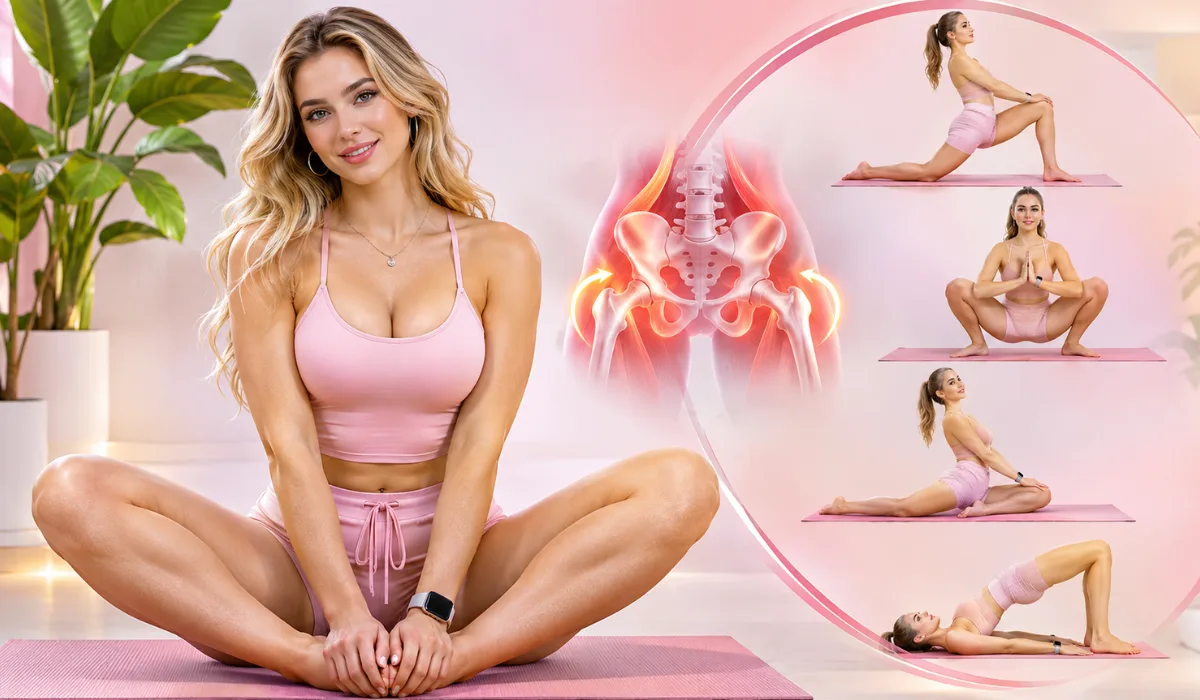
You might wonder, "Why are yoga poses important for improving hip mobility?" It is a great question. Modern life forces our bodies into unnatural shapes. We sit in cars, slump on couches, and hunch over office desks for hours on end. This sedentary lifestyle causes our hip flexors to tighten up and our glute muscles to switch off.
When your hips lose their natural range of motion, your body starts looking for shortcuts. Your lower back or your knees will start doing work they were never meant to handle, leading to chronic aches and pains. Practicing Yoga Poses For Improving Hip Mobility acts as a reset button for your skeletal system.
Opening the hips takes pressure off the lumbar spine, which directly reduces lower back pain. Furthermore, whether you run, lift weights, or swim, mobile hips allow for a longer, more powerful stride that boosts overall athletic performance. Free hips also help align your pelvis, enhancing daily posture and making it easier to stand tall and breathe deeply.
I noticed a massive shift in my posture within just two weeks of consistent practice. My chronic lower back stiffness simply melted away because my hips were finally doing their proper share of the work.
How Can Yoga Poses Improve Hip Mobility?
Understanding "How can yoga poses improve hip mobility?" comes down to understanding the nervous system and connective tissue. When you hold a stretch or engage in a mobility drill, you send safety signals to your brain. Over time, your nervous system learns that it is safe to let go of chronic muscle guarding.
Furthermore, Hip mobility and flexibility exercises in yoga combine passive lengthening with active muscular engagement. For example, when you practice Yoga for hips and glutes, you aren't just letting gravity pull you down; you are actively pressing your feet into the floor, engaging your core, and stabilizing your pelvis. This active control is what transforms temporary flexibility into permanent, usable mobility.
Top 10 Yoga Poses For Improving Hip Mobility
Here is my personal favorite sequence featuring the Top 10 Yoga Poses For Improving Hip Mobility. You can flow through these at your own pace. Remember to breathe deeply and never push yourself into sharp pain.
1. Child’s Pose
Start your practice on your hands and knees, bring your big toes together, and gently push your hips back toward your heels while reaching your arms forward. This posture works wonderfully because it subtly widens the knees, giving your inner thighs and lower back a safe, comforting stretch while calming your active mind.
2. Low Lunge
Step your right foot forward between your hands and softly lower your back left knee down to the floor. Keep your front knee stacked right over your ankle, lift your chest proudly, and sweep your arms overhead to target the stubborn psoas muscles that get tight from constant daily sitting.
3. Lizard Pose
From your low lunge position, walk your front right foot out to the outer edge of your mat and bring both hands to the inside of your foot, lowering onto your forearms if it feels comfortable. This serves as an advanced-beginner powerhouse for opening the inner groins and deep hip flexors.
4. Butterfly Pose
Sit tall on your mat, bend your knees, and press the soles of your feet together, letting your knees drop open to the sides like butterfly wings while you gently hinge forward. This improves inner thigh flexibility and increases healthy blood flow to your entire pelvic region.
5. Garland Pose
Stand with your feet a bit wider than your shoulders, turn your toes outward, and sink your hips down into a deep squat with your palms pressed together at your heart. It combines ankle, knee, and hip flexion, perfectly mimicking a natural human resting posture that keeps your joints lubricated.
6. Pigeon Pose
From a tabletop position, slide your right knee forward behind your right wrist and angle your shin toward the left side of the mat, extending your left leg straight back behind you. This is widely considered the gold standard for opening tight outer glutes and releasing deep external hip rotation tension.
7. Reclined Figure Four Pose
Lie flat on your back with both knees bent, cross your right ankle over your left thigh to create a shape, and thread your hands through to pull your left thigh toward your chest. It offers a safe, floor-supported way to stretch your outer hip and piriformis muscle without straining your knees.
8. Happy Baby Pose
Lie flat on your back, hug your knees into your chest, open them wider than your torso, and reach up to grab the outer edges of your feet, stacking your ankles directly over your knees. It releases unwanted tension in your lower back and deeply opens the inner groin area.
9. Goddess Pose
Step your feet wide apart, turn your toes outward at a forty-five-degree angle, and bend your knees to drop your hips down while keeping your torso upright and lifting your arms into cactus shapes. This is an incredible addition to Yoga for hip mobility and strength, because it builds massive endurance in your thighs while opening your hips dynamically.
10. Ninety-Ninety Seated Stretch
Sit on the floor with your right knee bent ninety degrees in front of you and your left knee bent ninety degrees out to the side, slowly switching your knees from side to side. This specifically targets Yoga poses for improving internal hip rotation, an essential movement pattern that traditional yoga styles often neglect.
Read Also: 10 Best Poses: Yoga For Lower Back Flexibility
Best Yoga Poses For Improving Hip Mobility Using Props
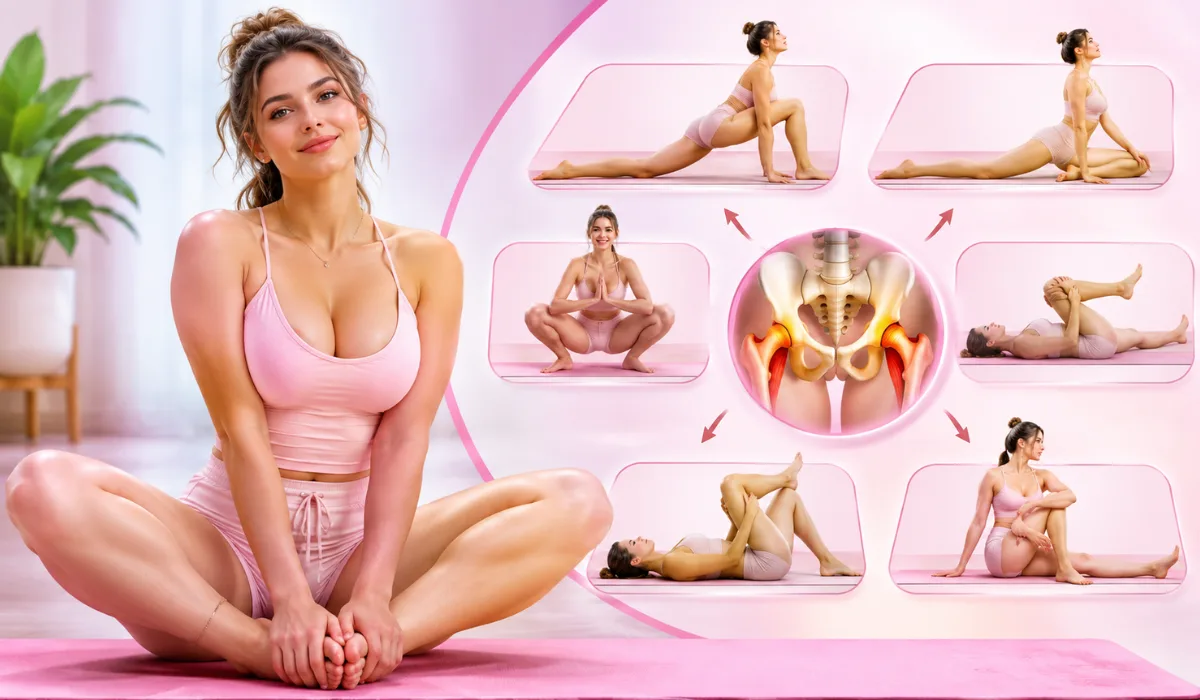
If your hips feel stiff, do not let ego get in the way. Using blocks, straps, and folded blankets changed my practice entirely. Yoga poses for improving hip mobility with props allow you to bridge the gap between your current flexibility and the ideal shape of a posture.
You can slide yoga blocks underneath your hips in Garland Pose or Pigeon Pose if your sit bones do not comfortably reach the floor, which eliminates tension and lets your muscles actually relax. If you cannot comfortably reach your feet in seated stretches, you can loop a yoga strap around your arches to keep your spine tall and proud. Additionally, you can place bolsters and blankets under your knees in Butterfly Pose to stop them from straining mid-air.
As renowned yoga educator Elena Brower notes: "Props are not crutches; they are intelligent tools that invite ease into the body so your nervous system can finally let go."
Daily Routine vs. Specialized Workouts: Finding What Works
When you want to build a sustainable practice, consistency beats intensity every single time. Let’s look at how you can structure your week.
If you are pressed for time, a quick 15-minute daily flow keeps your joints oiled and happy. You can spend the first three minutes in Child’s Pose and gentle Cat-Cow movements to warm up, followed by minutes four through eight holding a Low Lunge on each side for sixty seconds. Then, spend minutes nine through twelve in Butterfly Pose with a gentle forward fold, and finish with Reclined Figure Four to cool down.
Alternatively, building a Daily Yoga Routine For Improving Hip Mobility by doing a short, gentle sequence every morning before work wakes up your nervous system and reverses the stiffness accumulated during sleep and daily sitting.
Advanced Hip Opening Yoga Poses and Internal Rotation
Once you have mastered the basics, you might want to explore Advanced hip opening yoga poses. These movements require a deep blend of flexibility, strength, and patience.
You can practice Firelog Pose by stacking your shins directly on top of one another to create an intense external rotation challenge. Another option is Compass Pose, which is a breathtaking posture combining a deep hamstring stretch with a powerful shoulder-and-hip opening twist. You can also look into the Sleeping Yogi pose, where you place your foot entirely behind your head as an extreme test of overall hip socket mobility.
Crucially, do not neglect Yoga poses for improving internal hip rotation. Most yoga styles focus heavily on opening the hips outward through external rotation. To keep your joints healthy, you also need to practice internal rotation movements, such as windshield-wiper leg drops while lying on your back.
Yoga vs Stretching Exercises For Hip Flexibility
People often ask me whether they should just do basic static stretching or commit to a full yoga practice. When comparing Yoga vs stretching exercises for hip flexibility, yoga offers a distinct advantage through mindful control. Standard static stretching primarily focuses on lengthening muscle tissue passively and can often feel rushed or mindless. In contrast, yoga poses for hip mobility combine strength, balance, and range while keeping your breath synchronized to lower cortisol.
Furthermore, standard stretching offers low focus on supporting muscles and leaves joint stability out of the equation. Yoga brings a high focus on active joint stabilization. While static stretching is often isolated to targeted muscles, yoga delivers full-body benefits that integrate your shoulders, spine, core, and legs. Yoga teaches you how to breathe through discomfort and builds functional strength around the joint, keeping you safe from injury.
Read Also: 10 Best Yoga Routine For Daily Wellness Ideas You Can Do at Home
Expert Opinions and Real-World Insights
To give you the most trustworthy guidance possible, let’s look at what movement experts say about integrating these practices into your life.
"When we look at hip mobility through the lens of longevity, the goal is independence. People who can comfortably transition from the floor to standing without using their hands maintain their independence much longer as they age. Yoga gives us a playful, accessible sandbox to maintain that physical autonomy." — Dr. Marcus Vance, Sports Orthopedic Researcher
My own experience echoes this entirely. When I started treating my hip mobility practice not as a chore, but as a daily hygiene routine for my joints, everything clicked. I could run further, sit longer without discomfort, and move through my day with absolute confidence.
Frequently Asked Questions
1. How often should I practice yoga poses for improving hip mobility?
For the best results, aim for a short ten-to-fifteen-minute routine daily, or a deeper thirty-minute practice three to four times a week. Consistency is far more effective than doing one massive session once a week.
2. Can tight hips cause lower back pain?
Yes, absolutely. When your hips lack the mobility to move freely, your lower back often compensates by moving too much, which leads to chronic strain and discomfort.
3. Should I feel pain when doing hip-opening yoga poses?
Never push through sharp or shooting pain. You should feel a dull, manageable muscular stretching sensation or a mild discomfort, but if your joints hurt or pinch sharply, back out immediately and use props.
4. Are these poses safe for beginners?
Yes! Every pose mentioned in this guide can be scaled down or modified using blocks, straps, or blankets to match your current flexibility level.
Conclusion: Take the First Step Today
Improving your physical freedom doesn't require a miracle—it just requires showing up for yourself a few minutes every single day. By practicing Yoga Poses For Improving Hip Mobility, you are investing in a lighter, more agile, and pain-free body. Roll out your mat, take a deep breath, and remember that progress happens slowly, one mindful stretch at a time. Your hips will thank you!